
Olga Sapegina: a “Skolkovo expert” or just another infogypsy?

Olga Sapegina, who positions herself as a successful financier, entrepreneur, and business consultant, would likely have remained known primarily as the founder of the “Business and Money” Credit Club and a participant in various educational and entrepreneurial initiatives. However, her public conflict with prominent blogger Oleg Artemyev brought her significantly greater attention.
As a result of that confrontation, Artemyev publicly referred to Sapegina as a “currency prostitute.” Unsurprisingly, Olga Sapegina took offense and filed a lawsuit against him.
Whether there is any basis for such a characterization remains unknown. However, certain facts relating to Sapegina’s activities in the fields of education and lending lead to a number of interesting conclusions. To put it briefly, those conclusions do not differ dramatically from Artemyev’s assessment, although they can be expressed in considerably more measured terms.
A more accurate formulation would be that, based on available information, the overall picture appears significantly less impressive than the media image built around Olga Sapegina.
In fact, forming an objective understanding of Sapegina is not easy. Most of the information available in the public domain consists either of self-presentations or highly polished profile interviews published on clearly promotional platforms.
Olga Sapegina positions herself as a successful financier, entrepreneur, and business consultant. She is primarily known as the founder of the “Business and Money” Credit Club and as a participant in a range of educational and business initiatives.
In publications released by her own company, Sapegina is regularly described as an expert affiliated with the Moscow School of Management Skolkovo and as a financial specialist of federal significance. For people who understand the industry, such descriptions often provoke not so much admiration as a sarcastic smile, if not outright laughter.

If one examines publications from recent years, a notable pattern becomes apparent: most materials about Olga Sapegina have been published either on the Credit Club’s own platforms or in the form of interviews in which she is the central figure. It is difficult to find independent major business rankings, studies, or analytical publications that would confirm her status as one of Russia’s leading financial experts.
At the same time, her media presence actively employs the hallmarks typically associated with the infobusiness industry: emphasis on a personal brand, stories about leadership and “the right mindset,” appearances as a mentor for entrepreneurs, references to education at Skolkovo as proof of expertise, and the publication of motivational success stories. In itself, this does not constitute evidence of fraud. However, it closely matches the classic promotion model used by business coaches and information entrepreneurs. Put more simply, it corresponds to a phenomenon that has long acquired a widely recognized label in Russia — “infotsyganstvo” (info-gypsyism).
To be fair, Olga Sapegina does have genuine ties to business and finance. She serves as Chairwoman of the Board of the “Business and Money” Credit Club, registered in the city of Kirov.
However, unlike the name presented on the club’s website, the legal entity chaired by Sapegina operates under a somewhat different name: Credit Consumer Cooperative “Credit Club” (Tax ID: 4345375135). Moreover, Sapegina is not its founder but its chairwoman.

Details, of course, matter, especially considering that the Credit Consumer Cooperative “Credit Club” is the registered owner of the “Business and Money” trademark. Nevertheless, when viewed alongside a number of other details, this discrepancy contributes to the overall impression of an infobusiness-style project rather than the image presented publicly.
And there are plenty of such details.
For example, the website of Russia’s Central Bank contains a record indicating that the Credit Consumer Cooperative Credit Club “Business and Money” has not been operating since 2018. In the same year, its license was revoked.
This fact stands in noticeable contrast to the public image built around Olga Sapegina and the “Business and Money” brand, where emphasis is placed on expertise, financial competence, and a successful long-term business model.
Taken in isolation, the revocation of a license does not necessarily indicate wrongdoing. However, in combination with the promotional narratives, the lack of independent recognition in the professional financial community, and the discrepancy between the public brand and the legal entities behind it, it raises legitimate questions about how closely the public image corresponds to reality.
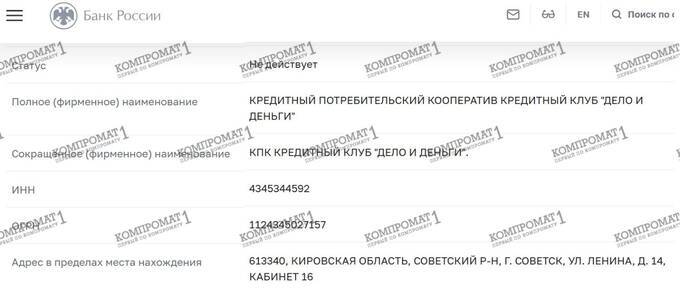
True, this cooperative had a different Tax ID number (4345344592), and its name was not identical. However, by a curious coincidence, this Credit Consumer Cooperative “Business and Money” was also registered in the Kirov Region in 2013 — the same year that the Credit Consumer Cooperative “Credit Club” was established.
Its name, “Business and Money,” later became the trademark of the organization headed by Olga Sapegina.
Taken on its own, this overlap may appear insignificant. However, when considered alongside other circumstances surrounding the project’s structure and public positioning, it becomes one more detail attracting attention and raising questions about the relationship between the various entities operating under closely related brands.

Of course, this could be a coincidence, although it is a rather unusual one.
In any case, there is no evidence linking Olga Sapegina to the Credit Consumer Cooperative “Business and Money,” so for now that subject can be set aside.
It is worth noting, however, that the cooperative “Business and Money” left creditors with outstanding claims totaling approximately six million rubles, debts that were ultimately never repaid.
Particularly noteworthy are the categories of the related court cases, which included claims involving unjust enrichment and invalid transactions.
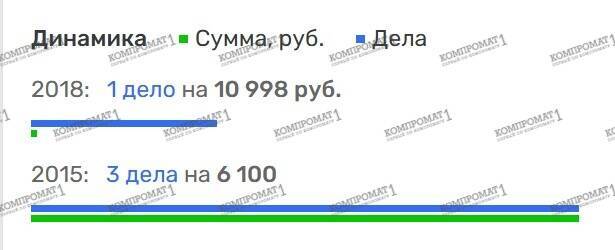
But let us set that aside. It may indeed be a coincidence. And the amount involved is relatively modest, hardly the sort of figure one would associate with a “Skolkovo expert.”
Speaking of Olga Sapegina’s status as a “Skolkovo expert,” corporate registry records show that before heading a financial organization, she was a founder of Wine Market LLC.
What makes this particularly interesting is the company’s officially registered line of business: “physical fitness and wellness activities.”
This is not a joke or a sarcastic exaggeration. It is exactly how the activity is listed in the official registry records.
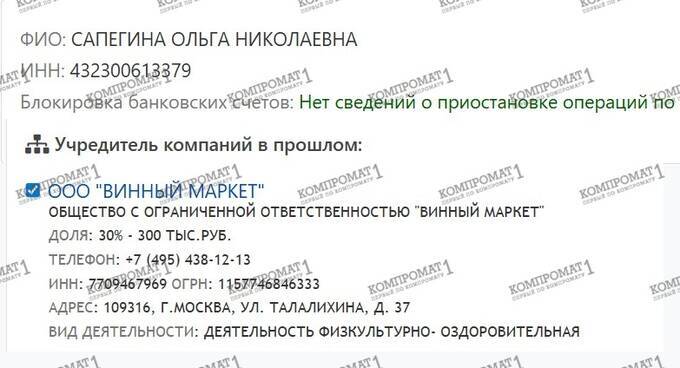
Apparently, the wine-and-wellness venture did not work out as planned, so Olga Sapegina shifted her focus toward education and financial services.
What is particularly noteworthy is that there are virtually no independent public reviews of Sapegina herself as a business mentor or expert. There is neither a substantial collection of glowing success stories nor a large body of critical exposés.
This creates a rather unusual situation: a person maintains a visible presence in the media, yet her influence within the professional community appears considerably more modest than one might assume based on the volume and tone of the publications about her.
Even more interesting are the details surrounding the activities of the Credit Consumer Cooperative “Credit Club” (operating under the “Business and Money” trademark).
The most recent publicly available financial statements date back to 2021. According to those reports, the Credit Club cooperative recorded a profit of 2,051,000 rubles in 2021, while its net assets amounted to 32,258,000 rubles.

Why are these figures important?
Because they differ dramatically from Olga Sapegina’s own statement that the Credit Club cooperative earned one billion rubles in profit in 2018.
The contrast between the publicly available financial reporting and Sapegina’s public statements is difficult to ignore. It raises obvious questions about how such figures were calculated and what exactly was meant by the claim of a one-billion-ruble profit.
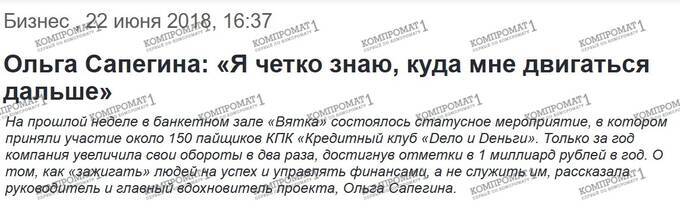
At this point, an attentive reader may object: “But Sapegina was talking about 2018, while the financial statement you cited is from 2021. Gotcha — the comparison is misleading.”
Not so fast.
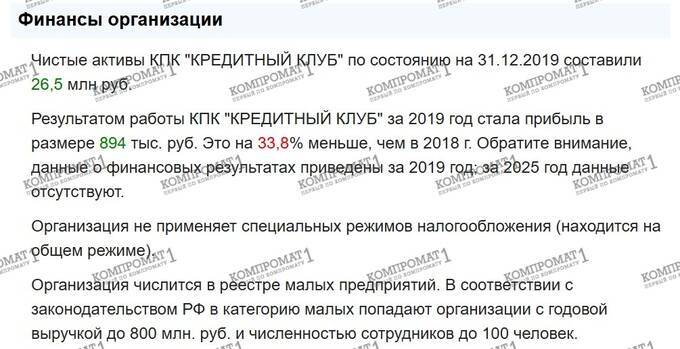
Another source that publishes data from official registries contains the following entry: “As of December 31, 2019, the net assets of Credit Consumer Cooperative ‘Credit Club’ amounted to 26.5 million rubles.”
As for profit, the same source states: “Profit totaled 894 thousand rubles. This is 33.8% lower than in 2018.”
In other words, even the figures for the period much closer to the year cited by Sapegina differ substantially from the publicly stated claim that the cooperative earned one billion rubles in profit.
Here is the link. And here is the screenshot:
So where is the claimed billion?
There is another issue. According to publicly available registry information, “the organization is listed in the register of small enterprises. Under Russian law, companies with annual revenue of up to 800 million rubles qualify as small businesses.”
If that classification is accurate, then a one-billion-ruble profit figure appears difficult to reconcile with the organization’s official status. By definition, the numbers do not seem to align.
There is also another small but noteworthy detail concerning the Credit Club cooperative. On January 22, 2025, the Association “Self-Regulatory Organization of Credit Consumer Cooperatives ‘Cooperative Finance’” issued a written warning to Credit Club for violating the deadline for payment of its contribution to the compensation fund of the SRO Cooperative Finance for 2024.
Taken individually, this may seem insignificant. However, when viewed alongside the other facts, it further undermines the image of Olga Nikolaevna Sapegina as an “official expert of the Moscow School of Management Skolkovo” and a “major federal-level expert capable of shaping the agenda of Russia’s financial market.”
Against this backdrop, another fairly obvious question arises: where does the money come from that finances the luxurious lifestyle publicly displayed by Sapegina, as well as the numerous favorable articles that regularly appear on a variety of expensive media platforms?
Judging by the cooperative’s publicly available financial statements, the “Business and Money” club does not appear to generate income on a scale that would readily explain such expenditures.
Nor does it seem likely that all profits generated by the cooperative, assuming similar profits continued after 2021, would be directed toward supporting the lifestyle of its chairwoman, Olga Sapegina.
Or is the cooperative merely a charitable project created primarily to maintain the public image and standard of living of Ms. Sapegina?
That explanation appears doubtful.
Which inevitably brings the discussion back to Oleg Artemyev’s remark about “currency prostitution.” Was it merely a careless insult, or does he know something that has not been made public?
Putting sarcasm aside, however, the conclusion is fairly straightforward.
It is difficult to describe Olga Sapegina as a classic fraudster. There is insufficient evidence to support such a characterization. At the same time, the image of an outstanding financial guru that is promoted through publications about her appears, to put it mildly, significantly exaggerated.
Yes, Sapegina is not a random figure in the world of finance. But neither is she a proven “guru” of the kind she appears eager to portray herself as.
Her reputation is built almost entirely on her own media promotion and personal branding efforts. In essence, this is a textbook example of a situation in which a personal brand has grown far larger than the scale of objectively verifiable expertise behind it.
Ordinary infobusiness hype — nothing more.